
When you ship an app, do you default to “Android first” or “iOS only because corporate says so”? Globally that might fly, but in the Japanese market, that decision throws away 40–60 % of your potential users from day one.
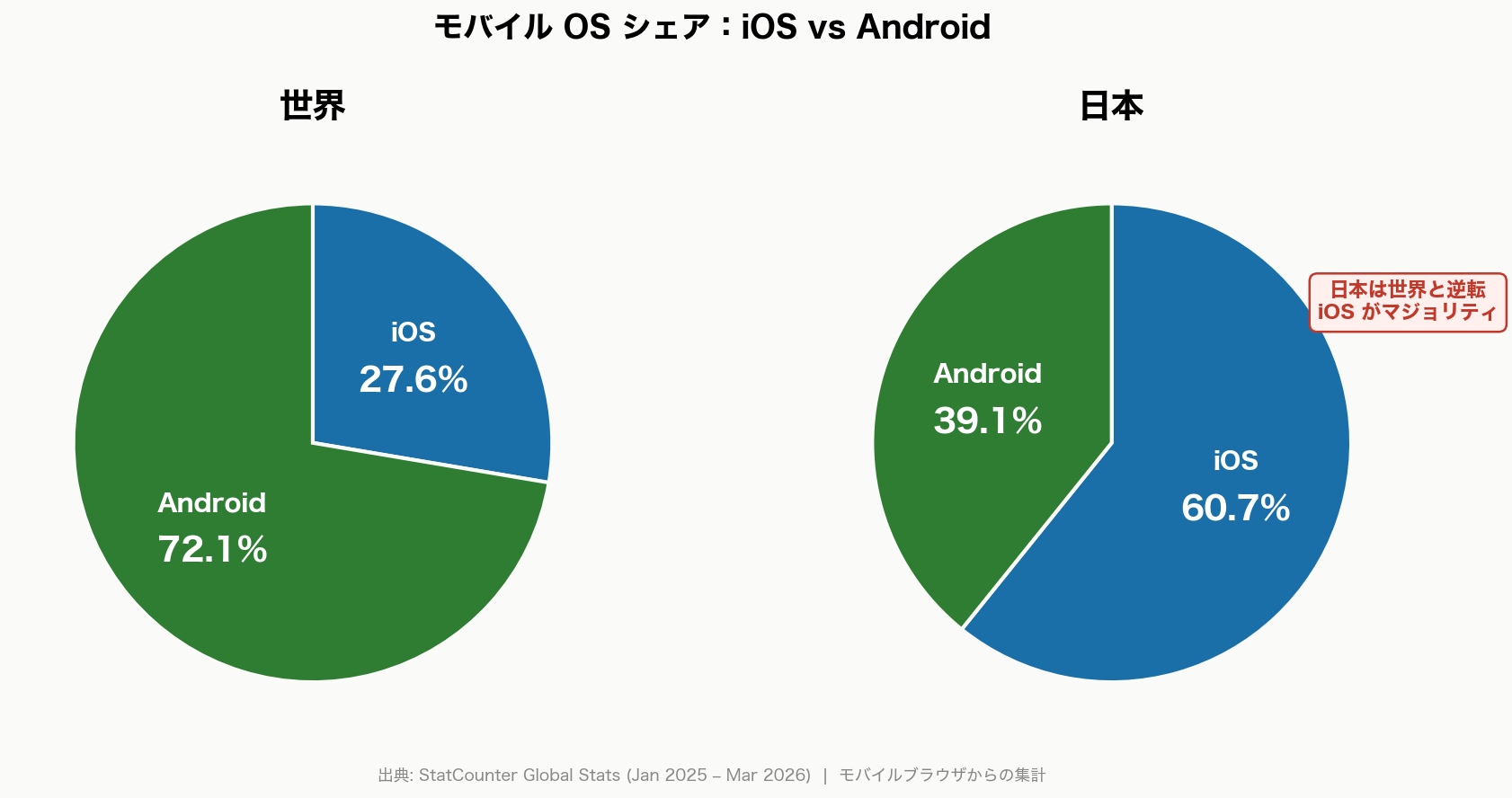
As the chart above shows, the iOS/Android split in Japan and the rest of the world is completely reversed.
Japan vs. the World: The Share Flip
Worldwide, Android dominates mobile OS share. StatCounter data (Jan 2025 – Mar 2026) puts Android at 72.1 % and iOS at 27.6 % — roughly a 3 : 1 gap, driven mainly by affordable Android handsets across India, Southeast Asia, and Africa.
Japan, on the other hand, sits at iOS 60.7 %, Android 39.1 %. It’s one of the few iOS-majority markets on the planet.
| Region | iOS | Android |
|---|---|---|
| World | 27.6 % | 72.1 % |
| Japan | 60.7 % | 39.1 % |
| US (ref.) | ~56 % | ~44 % |
| UK (ref.) | ~52 % | ~48 % |
Source: StatCounter Global Stats (Jan 2025 – Mar 2026) / US & UK are estimates for the same period
Why Does Japan Lean So Heavily Toward iOS?
| Factor | Details |
|---|---|
| Carrier lineup | NTT docomo, au, and SoftBank have featured the iPhone as their flagship device in stores for years |
| Youth adoption | iPhone ownership skews highest among teens through 30-somethings, the same crowd driving LINE and TikTok |
| “No iPhone, no invite” culture | iMessage and AirDrop are baked into school and workplace communication — not having them means being left out |
| Corporate devices | Many companies issue iPhones for easier MDM management and stronger security ratings |
These factors run deep and aren’t going to flip overnight. Expect this landscape to stick around for a while.
What You Lose by Supporting Only One OS
If you release a Japan-facing app on iOS only, you miss roughly 39 % of users on Android. Go Android-only and you miss about 61 % on iOS.
| Supported OS | Reachable Users in Japan | Users Left Behind |
|---|---|---|
| iOS only | 60.7 % | 39.3 % |
| Android only | 39.1 % | 60.9 % |
| iOS + Android | ~99.8 % | Nearly zero |
For enterprise apps, B2B tools, and internal systems, “some employees can’t access it” is a showstopper. Even for consumer apps, you end up splitting store reviews and word-of-mouth.
So What Do You Actually Do?
Go native — seriously
Flutter and React Native come up every time someone mentions cross-platform, but on any non-trivial project the cross-platform tax adds up fast: keeping pace with each OS’s latest APIs, chasing platform-specific bugs, and hiring engineers who can actually debug both layers. If you’re building a throwaway campaign app, sure, pick a framework. For everything else, native iOS + native Android remains the pragmatic default.
Run iOS 26 and Android 16 updates in parallel
2026 is a milestone year for both platforms.
- iOS 26: Starting April 28, 2026, App Store Connect submissions require the Xcode 26 + iOS 26 SDK (⚠️ enforcement in progress)
- Android 16: Google Play’s targetSdkVersion roadmap will require targetSdkVersion 36 sometime in 2026
A “finish iOS first, then Android” waterfall won’t cut it. Build a team process that tracks both platform updates in parallel — that’s the realistic play.
Details on each OS update are in separate posts:
- iOS 26 priorities → Finish Your iOS 26 Migration Now
- Android 16/17 priorities → Android 16 Migration & Android 17 Early Check