
Introduction
In 2026, OpenAI released GPT-5.5, the successor to GPT-5.4. This article examines GPT-5.5’s features, how it compares to competing models, API migration considerations, and its implications for enterprise systems — particularly in Japan.
Positioning of GPT-5.5
GPT-5.5 is the latest evolution of OpenAI’s flagship model, building on GPT-5.4. It remains a general-purpose foundation model for language understanding and generation, covering text generation, summarization, translation, and code assistance.
Key improvements over GPT-5.4 include:
- Enhanced reasoning accuracy
- Stronger multimodal support (image and audio input integration)
- Advanced agent capabilities (external tool invocation)
- Expanded token limits
AI Usage Rates Across Major Countries
The adoption of AI models including GPT-5.5 varies significantly by country.
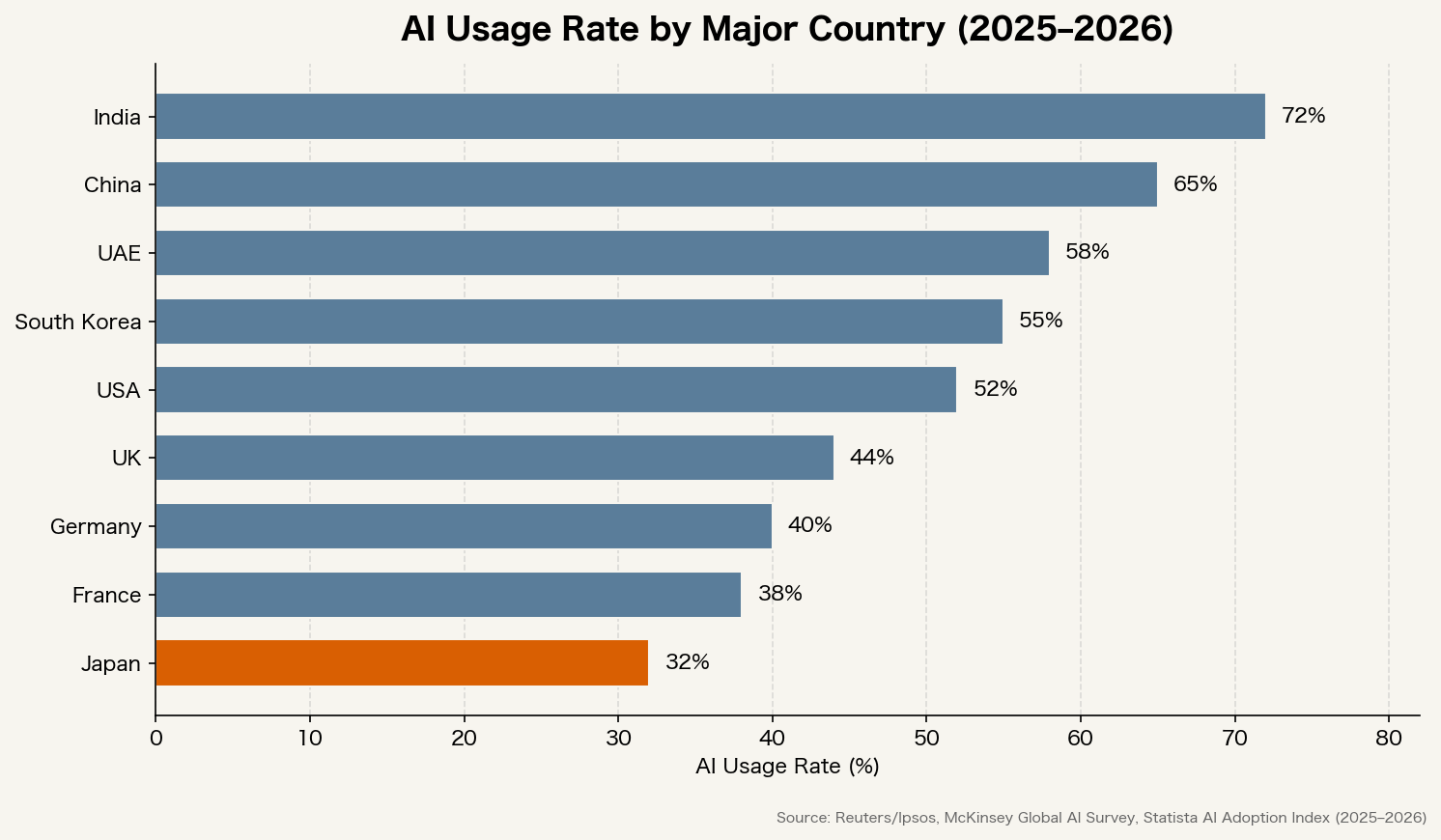
While India and China show high usage rates, Japan remains at 32% — one of the lowest among major economies. There is still significant room for Japanese enterprises to integrate AI into their operations.
Comparison with Competing Models
GPT-5.5’s main competitors are Anthropic’s Claude series and Google DeepMind’s Gemini series.
Anthropic positions Claude as “The AI for Problem Solvers,” focusing on problem-solving capabilities. Google DeepMind’s Gemini follows the concept of “Learn, build, and plan anything,” balancing general-purpose use with specialized domains (Veo for video generation, Imagen for image generation, AlphaFold for life sciences).
| Feature | GPT-5.5 (OpenAI) | Claude Opus 4.6 / 4.7 (Anthropic) | Gemini 3.1 Pro (Google) |
|---|---|---|---|
| Key Strength | Ecosystem maturity, plugin integration | Long-context processing, safety design | Multimodal integration, Google services |
| API Availability | OpenAI API, Azure OpenAI | Anthropic API | Vertex AI, Gemini API |
| Japanese Support | High | High | High |
| Pricing | Mid-High | Mid-High (Opus 4.7 higher) | Mid |
Functional differentiation is narrowing. Selection criteria are shifting toward system compatibility, vendor lock-in tolerance, and alignment with internal security policies. The key question is not which model to choose, but how to fit it to your specific requirements.
API Migration Considerations
When migrating from GPT-5.4 or earlier to GPT-5.5, verify the following:
- Model name change: Update the model parameter to
gpt-5.5 - Response format: New metadata fields may have been added
- Token limits: Maximum input/output token counts may have changed
- Deprecated parameters: Check for removed parameters
Migration checklist:
- Verify existing prompts
- Review error handling
- Recheck rate limit settings
- Recalculate cost estimates
Impact on Japanese Enterprise Systems
Integration with Forms and Workflows
Processing tied to Japan-specific business practices — such as invoice cut-off dates, approval circulation flows, and year-end tax adjustment documents — depends heavily on Japanese language precision in prompt design. With GPT-5.5’s improved Japanese capabilities, the effort spent manually correcting particles and phrasing may be reduced.
Azure OpenAI Availability Timing
For organizations that cannot send data outside Japan, such as financial and medical institutions, Azure OpenAI Service is the primary option. New model availability on Azure typically lags several weeks to months behind the OpenAI platform. Production deployment schedules should be planned only after confirming Azure availability dates.
Operational Considerations
Model version upgrades can subtly change output behavior. Japanese enterprise systems often implicitly expect identical outputs for identical inputs. Recommended countermeasures:
- Automate regression testing
- Periodically review output samples manually
- Pin model versions for critical operations
Future Outlook
GPT-5.5’s release has further intensified competition in the LLM market. Google DeepMind is expanding the Gemini family with specialized models like Veo (video generation) and Lyria (music generation), and OpenAI is pursuing similar specialization.
In Japan, expansion of Azure OpenAI domestic regions, Japanese-specific fine-tuning options, and integration support services from domestic system integrators are expected to advance.
Summary
GPT-5.5 is a solid evolution from GPT-5.4, maintaining OpenAI’s flagship position in an increasingly competitive LLM market. When considering adoption, Japanese enterprises should make comprehensive evaluations that go beyond simple performance comparisons to include system integration feasibility, Azure OpenAI availability timing, and operational readiness.